
 English
 中文简体
中文简体 русский
 Español
 عربى
عربى


Why Is the 7.5oz Paper Cup the Standard Choice for Automatic Vending Machines?
Walk up to almost any hot drink vending machine in an office lobby, hospital corridor, or transit hub, and the cup that drops into the dispenser is almost always a 7.5oz paper cup. This size has become the de facto standard for automatic vending machines globally, and that is no accident. The 7.5oz format balances volume, material cost, machine compatibility, and consumer expectation in a way that no other size quite matches. Understanding why this cup works — and what to look for when sourcing them — is essential for anyone managing vending operations, procurement, or foodservice supply chains.
What Makes 7.5oz the Right Volume for Vending Applications
The 7.5oz capacity — equivalent to approximately 220ml — sits at a practical midpoint between an espresso-style short drink and a large coffee. Most automatic vending machines are programmed to dispense between 150ml and 200ml of liquid per serving, which means a 7.5oz cup provides enough headroom to prevent overflow while still feeling adequately filled to the person receiving it. A smaller cup, such as a 4oz or 5oz option, risks spilling when the machine's dispensing nozzle runs slightly hot or when the cup shifts during filling. A larger cup, such as a 9oz or 12oz format, wastes material and creates a visually underwhelming serve.
The 7.5oz volume is also well-suited to the typical vending machine drink menu: instant coffee, tea, hot chocolate, and soup. These are single-serving beverages consumed quickly and on the move, where a compact cup is more convenient to hold and carry than a larger format. The cup fits naturally in one hand without requiring a sleeve or secondary holder, which keeps the vending transaction simple and fast.
Construction and Material Standards for Vending Cups
Not every paper cup labeled as 7.5oz is suitable for automatic vending machine use. Vending-specific cups are engineered to meet mechanical requirements that standard beverage cups do not need to address. The most important of these is dimensional consistency. Vending machines use spring-loaded cup dispensers that grip the cup stack and release one cup at a time. If the cup diameter varies even slightly between production batches, the dispenser will either jam or release multiple cups at once — both of which create machine downtime and waste.
Wall Construction and Heat Retention
The standard construction for a 7.5oz vending cup uses a single-wall paper body with a PE (polyethylene) lining on the interior. The PE coating prevents liquid from soaking through the paper wall, which would cause the cup to weaken and collapse. For hot drink applications, the PE lining also acts as a moisture barrier that slows heat transfer from the liquid to the outer paper wall, allowing the cup to be held comfortably for a short period. Some premium vending cups use a double PE coating or a PLA (polylactic acid) lining as an alternative that supports recyclability claims.
Rim and Base Specifications
The rolled rim at the top of a vending cup serves two purposes: it strengthens the opening against deformation under the dispenser's release mechanism, and it creates a smooth drinking edge. The base of the cup must be flat and consistently formed, as the cup sits on a platform inside the machine while being filled. A warped or off-center base can cause the cup to tilt, resulting in spillage or incomplete filling. Quality vending cups are produced with tight dimensional tolerances — typically ±0.3mm on the top diameter — to ensure reliable performance across all major vending machine brands.
Key Specifications to Compare When Sourcing 7.5oz Vending Cups
When evaluating suppliers or placing bulk orders, comparing technical specifications side by side helps avoid compatibility problems and cost surprises. The table below outlines the main parameters relevant to 7.5oz paper cups for automatic vending use:
| Specification | Typical Range | Why It Matters |
| Top Diameter | 70mm – 74mm | Must match machine dispenser tube diameter |
| Base Diameter | 48mm – 52mm | Affects cup stability on the drip platform |
| Cup Height | 75mm – 82mm | Determines fit in dispenser column depth |
| Paper Grammage | 170 – 210 GSM | Influences rigidity and heat resistance |
| Interior Lining | PE or PLA | Affects leak resistance and recyclability |
| Temperature Rating | Up to 90°C | Required for safe hot drink dispensing |
Always request a sample batch before committing to a large order. Run the sample cups through your specific vending machines to verify that the dispenser releases cleanly, the cup sits level on the platform, and no leaking occurs after filling with water at the machine's maximum dispensing temperature.
Machine Compatibility: Matching the Cup to Your Vending Brand
Different vending machine manufacturers specify slightly different cup dimensions, and using a cup that falls outside the tolerance range causes persistent operational problems. Major brands including Necta, Rheavendors, Bianchi, and Coffetek publish cup specification sheets in their technical manuals. Before sourcing cups from a new supplier, cross-reference the supplier's stated dimensions against the machine manufacturer's requirements.
The top diameter is the most critical measurement. Most European hot drink vending machines are designed around a 73mm top diameter cup, while some older or regionally specific models use 70mm or 74mm. A cup that is 2mm too wide will not drop from the dispenser; one that is 2mm too narrow will drop inconsistently, causing doubles. When managing a mixed fleet of machines from different manufacturers, it is sometimes necessary to stock two cup variants to ensure full compatibility across all units.
Bulk Purchasing: Quantities, Packaging, and Storage
7.5oz vending cups are typically sold in sleeve packs of 50 or 100 cups, with multiple sleeves packed into a carton. Standard carton quantities range from 1,000 to 2,500 cups depending on the supplier. For high-volume vending operations, purchasing in full pallet quantities — usually 50,000 to 100,000 cups — reduces the per-unit cost significantly and minimizes the frequency of reorder logistics.
Storage conditions affect cup performance. Paper cups should be stored in a dry environment away from direct sunlight and temperature extremes. Humidity causes the paper board to absorb moisture, which softens the cup wall and can cause dispenser jams. Ideally, cups should be stored at room temperature between 15°C and 25°C with relative humidity below 60%. Opened sleeve packs should be used within a short period rather than left exposed in high-humidity environments such as kitchens or basement storerooms.
Sustainability Considerations for Vending Cup Procurement
Environmental responsibility is an increasing factor in procurement decisions, and the single-use nature of vending cups places them under scrutiny. Several developments in vending cup manufacturing address these concerns in practical ways.
- Cups with PLA-based lining instead of PE are compostable in industrial composting facilities, making them a viable alternative where commercial composting collection is available.
- Some manufacturers now produce cups from FSC-certified paperboard, confirming that the raw paper fiber originates from responsibly managed forests.
- Cups printed with water-based inks rather than solvent-based inks reduce the chemical load in the waste stream and are generally considered more compatible with recycling processes.
- Several European suppliers now offer cups with a reduced PE lining weight — using 8–10 GSM of PE rather than the traditional 15–18 GSM — which marginally improves recyclability without compromising leak resistance for standard vending applications.
It is worth noting that sustainability claims on disposable cups vary widely in their practical impact. "Recyclable" paper cups are only actually recycled if the end user has access to a facility that accepts PE-lined paper cups — which remains limited in many regions. When making sustainability-based procurement decisions, consider the actual waste infrastructure available at your vending locations rather than relying solely on the cup manufacturer's labeling.
Custom Printing on 7.5oz Vending Cups
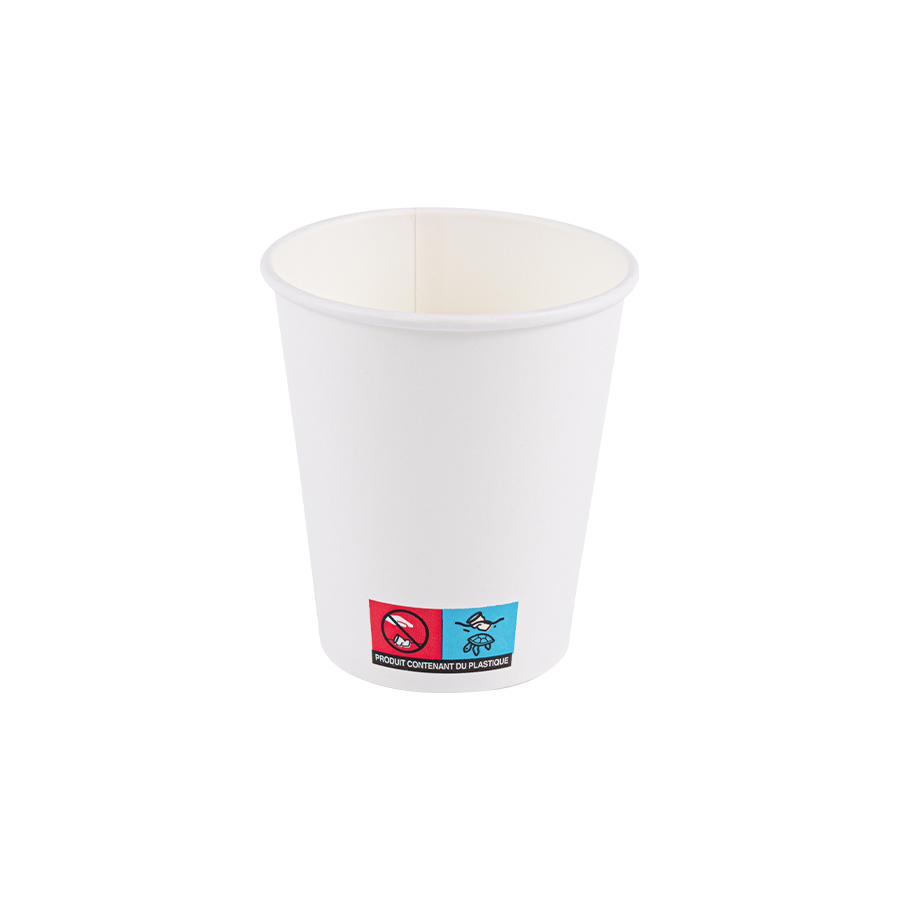
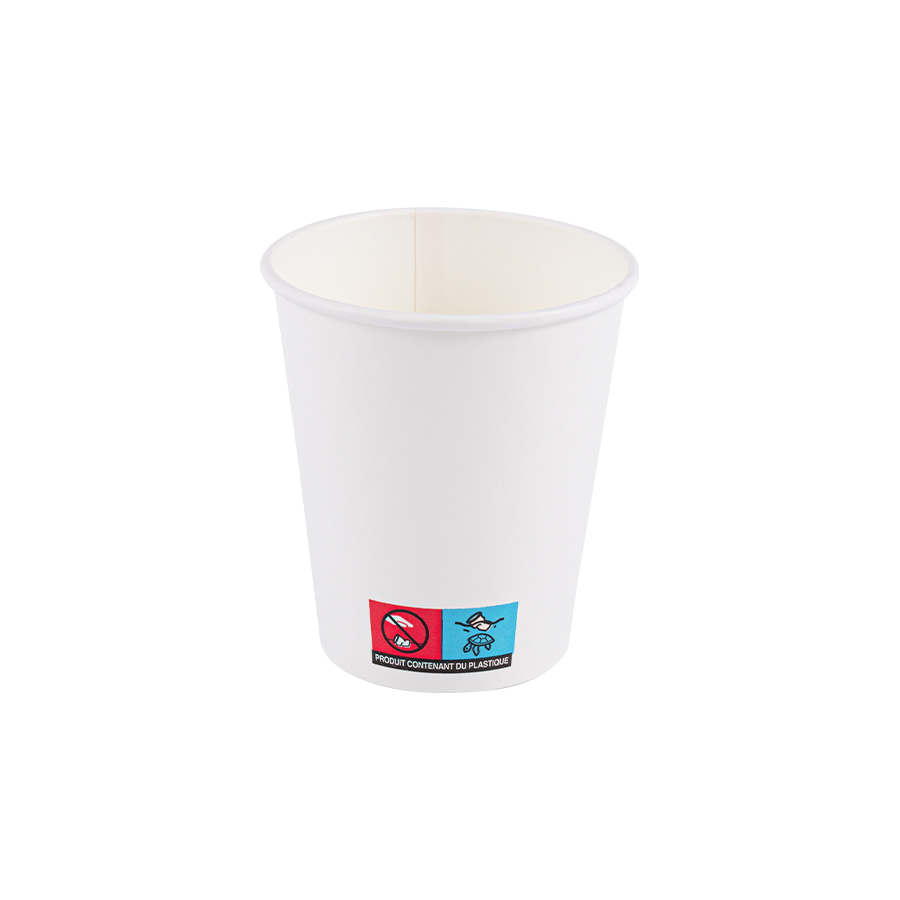
Plain white vending cups are the default option for most operators, but custom-printed cups offer a low-cost branding opportunity that is particularly effective in corporate or branded environments. Most cup manufacturers offer single-color or full-color flexographic printing on minimum order quantities starting from around 50,000 units, though some suppliers accommodate shorter runs using digital printing methods at higher per-unit cost.
When specifying artwork for a vending cup, account for the tapered cylindrical surface — designs need to be created with cylindrical distortion in mind so that logos and text appear visually correct once the cup is formed. Most suppliers provide a print template showing the flat blank dimensions and the wrap area available for printing. Keep key visual elements within the safe zone, away from the seam line and the base fold, where print quality can be inconsistent.
For vending operators managing machines across multiple client sites, custom-printed cups reinforce professionalism and can be included as part of a service contract. They also help with brand recall in shared spaces such as office break rooms, where the cup is often the only visible brand touchpoint at the point of consumption.